







How to Choose the Best Solar Irradiance Sensor for Your Needs?

Choosing the best solar irradiance sensor can be a daunting task. With various models and features, it's easy to feel overwhelmed. Understanding how these sensors work is crucial. They measure solar energy received on a surface area, which is vital for solar energy applications.

Experience in the field can guide your decision. Consider your specific needs. Do you require high accuracy or long-term durability? Some sensors are designed for research purposes, while others cater to commercial use. Price and brand reputation also play important roles in making a wise investment.

Reliability is key when selecting a solar irradiance sensor. Not all models are created equal. Some offer advanced features like data logging and connectivity. However, not everyone needs these options. Sometimes, simpler models suffice. Reflecting on your requirements will help you make an informed choice.
How to Choose the Best Solar Irradiance Sensor for Your Needs?

Understanding Solar Irradiance: Definitions and Key Concepts

Solar irradiance refers to the power of solar radiation per unit area, typically measured in watts per square meter. Understanding this concept is vital for anyone interested in solar energy applications. It can affect the efficiency of solar panels and various agricultural practices. Accurate measurements of solar irradiance help in optimizing energy capture and understanding environmental impacts.

Choosing the right solar irradiance sensor involves recognizing key specifications. Look for sensors that can measure direct, diffuse, and total solar radiation. Additionally, consider the calibration and response time of the sensor. These factors significantly influence your data accuracy.

When selecting a sensor, reflect on your specific needs. Will it be used for research or commercial applications? Ensure the device is reliable and fits the intended purpose. Consulting experts can clarify complex technical terms that may arise in your search. Choosing wisely ensures you receive precise and actionable solar data.

Types of Solar Irradiance Sensors: An Overview of Common Technologies

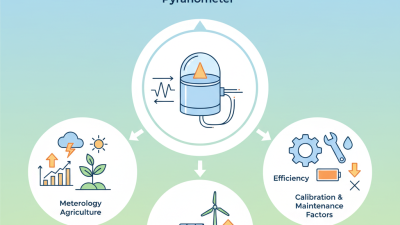
Solar irradiance sensors are critical tools for measuring solar energy. Understanding the different types can significantly impact their effectiveness in various applications. There are primarily three common technologies used in these sensors: silicon photodiodes, pyranometers, and quantum sensors. Each type has unique characteristics that cater to specific needs.

Silicon photodiodes are popular for their cost-effectiveness and responsiveness. They are effective in measuring solar radiation in a range of applications. Industry reports indicate that photodiodes can have a response time of under 10 microseconds, making them suitable for dynamic environments. However, their accuracy can be affected by temperature changes and wavelength sensitivity, which may require careful consideration.

Pyranometers offer higher accuracy and wide spectral response. They measure both direct and diffuse solar radiation, making them ideal for comprehensive solar assessments. According to the World Meteorological Organization, pyranometers can provide readings with a precision of up to ±5%. However, they are typically more expensive than photodiodes. Long-term exposure to environmental conditions can also affect their reliability.

Quantum sensors represent the latest technology. They are capable of measuring solar irradiance with high accuracy across a broad spectrum. These sensors are less influenced by temperature variations, yet they are still in the early stages of being adopted. Thanks to their advanced capabilities, quantum sensors offer significant advantages but also lead to discussions on their cost versus benefit ratio. Each type of sensor presents unique attributes that can either enhance or limit their application, making it essential to evaluate them carefully.

Solar Irradiance Sensors: Comparison of Common Technologies

This chart illustrates the performance comparison of different types of solar irradiance sensors based on their sensitivity (mV/W/m²) and response time (milliseconds). The data helps in understanding which sensor might be best suited for various applications.

Key Specifications to Consider: Accuracy, Sensitivity, and Calibration

When selecting a solar irradiance sensor, accuracy is crucial. A sensor with a high level of accuracy ensures that your measurements reflect real-world conditions. Industry reports indicate that irradiance sensors can have accuracy ratings ranging from ±2% to ±10%. This variability can significantly impact energy production estimates. For instance, a slight error in measurement can lead to miscalculations of solar panel output, potentially costing thousands in lost revenue.

Sensitivity is another critical specification. A highly sensitive sensor detects even minor fluctuations in solar irradiance. This is essential for applications like photovoltaic performance monitoring. Reports by energy research institutions reveal that sensitivity levels can vary widely. Some sensors can detect changes as small as 0.1 W/m², while others may require larger shifts to register changes. Choosing a sensor with appropriate sensitivity levels for your specific needs is vital for precise monitoring.

Calibration is often overlooked yet plays a significant role in accuracy. Regular calibration ensures that your sensor maintains its measurement integrity over time. According to industry standards, recalibration should occur at least once a year. Sensors that are not properly calibrated may provide misleading data, leading to faulty decision-making. It’s worth noting that many users neglect this aspect, undermining the reliability of their systems overall.

Application-Specific Requirements: Choosing Sensors for Different Environments

When selecting solar irradiance sensors, consider the specific environment where they will be used. Different applications, such as agriculture, urban infrastructure, or research laboratories, require unique sensor specifications. For instance, sensors used in agricultural fields must withstand outdoor elements and offer high precision. According to a report from the Solar Energy Industries Association, accurately measuring solar radiation can improve crop yields by up to 30% through optimized planting times and irrigation practices.

In urban areas, sensors need to address other challenges. High levels of pollution often affect readings. Research highlights that urban settings can experience a 20% reduction in solar irradiance due to atmospheric conditions. Thus, selecting sensors with built-in compensation for local atmospheric conditions becomes essential. Compact and lightweight sensors may also be ideal for temporary installations, catering to different urban applications, such as energy audits or solar panel ratings.

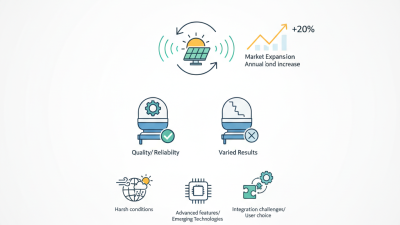
Lastly, certain environments may pose challenges in terms of data integration. If the sensor does not communicate effectively with existing systems, it can lead to less reliable data collection. A recent study indicated that nearly 15% of sensors in monitoring stations fail to sync with data platforms, resulting in gaps in crucial data. These nuances highlight the importance of choosing the right solar irradiance sensor tailored to specific environmental needs. Careful consideration of such factors can enhance overall sensor performance.

Cost-Benefit Analysis: Evaluating Sensors Based on Performance and Budget

When evaluating solar irradiance sensors, a cost-benefit analysis is crucial. The performance of a sensor should match your specific needs. Some sensors provide high precision, but at a higher cost. Conversely, budget-friendly options might offer less accuracy. It's essential to weigh these factors.

Consider the environment where the sensor will be installed. Harsh conditions may require robust models, which can increase costs. Think about installation expenses, too. You might save on cheaper sensors, but installation could negate those savings. Reliability is key. Sometimes, it’s better to spend a bit more for long-term gains.

Evaluate the long-term data needs. If precise readings are critical for your solar project, investing in a high-performance sensor pays off. Yet, for smaller applications, simpler models may suffice. Always reflect on your actual requirements. Balancing performance and budget can be challenging, but a thoughtful approach yields the best choice.

How to Choose the Best Solar Irradiance Sensor for Your Needs? - Cost-Benefit Analysis: Evaluating Sensors Based on Performance and Budget

Sensor Model Measurement Range (W/m²) Accuracy (%) Response Time (sec) Price ($) Value for Money
Model A 0 - 2000 ±2% 0.5 150 Good
Model B 0 - 1800 ±3% 1.0 100 Excellent
Model C 0 - 2200 ±1.5% 0.3 200 Good
Model D 0 - 2100 ±2.5% 0.7 120 Average
Model E 0 - 2500 ±2% 0.6 250 Good